
Blog
Double-Flanged Butterfly Valves: Five Project Interfaces to Confirm
5 November 2026
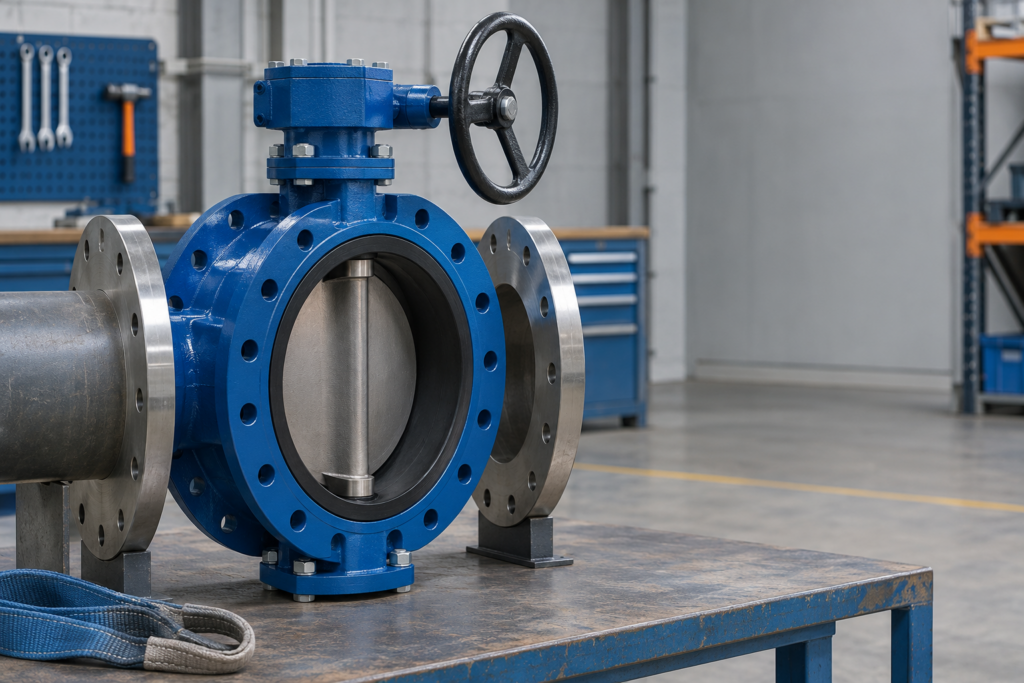
A double-flanged butterfly valve gives the project two complete valve-body flanges, but that description does not settle the installation. Face-to-face series, flange drilling, pipe alignment, package weight and the exact isolation rating still have to match the selected model and the surrounding pipework.
This guide focuses on those project interfaces. It complements the existing wafer-versus-lugged maintenance guide rather than repeating it.
Quick answer
Treat “double flanged” as the start of the interface check. Confirm the exact valve series, face-to-face dimension, flange standard and pressure designation, disc clearance, installation direction, weight and lifting points, actuator access, shut-off direction and any dead-end requirement. Manufacturer documents show that these details vary between models; the body pattern alone is not proof of interchangeability or suitability.
Why the interface record matters
A nominal size and pressure class do not define the whole installation. Two double-flanged valves can use different face-to-face series or flange drilling, and their instructions can impose different bolting, gasket, orientation, lifting and access requirements. Recording these interfaces before order placement reduces late pipework or support changes without inventing a universal product rule.
Five interfaces to confirm
| Interface | Project record | Evidence to obtain | Do not assume |
|---|---|---|---|
| Face-to-face | Required installed length and permitted tolerance | Exact model drawing and named standard/series | All double-flanged bodies have the same length |
| Pipe flanges | Standard, PN/Class, facing, bore and bolt pattern | Manufacturer data and project flange specification | Nominal size alone establishes fit |
| Alignment and disc envelope | Parallel flange faces, centred bore and clearance through travel | Installation manual and piping drawing | Bolts can pull misaligned pipework into place |
| Weight and support | Valve, actuator and accessories; lifting and support plan | Certified weight/drawing and lifting instructions | The actuator is a lifting point |
| Isolation and operation | Flow direction, shut-off duty, end condition and access | Model-specific pressure/temperature and dead-end statement | Double-flanged means any dead-end duty |
1. Lock the face-to-face series
Record the available installed length and the exact face-to-face standard and series. AVK, for example, publishes EN 558 Table 2 Basic Series 14 for a named double-eccentric model. Bray publishes ISO 5752/EN 558 Series 13 for a different named double-flanged family. Those examples demonstrate why “double flanged” does not define one universal length.
If replacing an existing valve, measure the accessible installation, photograph the nameplate and retain the old drawing if available. Do not select from nominal diameter alone.
2. Match both pipe flanges
State the flange standard and pressure designation on each side, plus facing, bore, gasket arrangement and bolt details. AVK’s named model lists EN 1092-2 drilling, while Bray’s product families show model-specific ASME and EN options. Confirm the selected variant rather than treating a published range as evidence for every size or material.
3. Prevent pipeline stress and disc interference
Valmet’s installation instructions require the pipe-end flange holes to be aligned, the sealing faces parallel and the valve free from stress caused by twisted flanges. The same manual requires attention to pipe inside diameter and the disc position during installation.
Record the adjoining pipe bore, liners, gaskets and any reducer or fitting close to the valve. The disc must travel without contacting them. Misaligned pipework should be corrected by the piping method, not forced into position with valve bolts.
4. Plan lifting, support and actuator access
Use the order-specific package weight. Valmet directs lifting ropes to the valve body rather than the actuator and calls for a hoist for heavy valves. The permanent arrangement also needs clear access to the actuator, gearbox, position indication and maintenance points.
The project record should show the lifting method, centre of gravity where supplied, pipe support around the installation and whether an actuator extension or platform is needed. These are layout decisions, not benefits automatically supplied by the body style.
5. Separate body pattern from duty approval
Bray identifies wafer, lug and double-flanged versions within one high-performance family and publishes model-specific dead-end statements. This is useful evidence for those named models, but it is not a general rule for every double-flanged valve.
State the medium, pressure, temperature, differential pressure, flow direction, required shut-off, operating frequency and any condition with one side open or removed. Obtain written confirmation against the exact series, size, seat and body construction.
What to send with an enquiry
- Photographs of the existing valve, both pipe flanges and nearby supports.
- Manufacturer, model, size, pressure designation and readable nameplate details.
- Required face-to-face dimension and named standard/series.
- Flange standard, facing, bore, bolt pattern and gasket requirement on both sides.
- Medium, pressure, temperature and differential pressure.
- Isolation or control duty, flow direction, operating frequency and end condition.
- Operation, fail action, controls and supply.
- Weight/access limits, certification, quantity, destination and required date.
Browse the butterfly-valve range or send the project interfaces for a model-specific review.
Frequently asked questions
Is every double-flanged butterfly valve interchangeable?
No. Check face-to-face series, flange drilling and facing, pressure-temperature limits, disc clearance, materials, actuation and the manufacturer’s instructions.
Can the pipe bolts correct misalignment?
No. Manufacturer instructions require aligned, parallel pipe flanges so installation does not impose stress on the valve.
Can I lift an actuated valve by the actuator?
Not unless the exact manufacturer’s instructions explicitly provide for it. The cited Valmet manual directs lifting ropes to the valve body, not the actuator.
Does double-flanged mean suitable for dead-end service?
Not by itself. Obtain the exact product’s written rating for the size, construction, temperature, direction and end condition.
Talk to Valves4You about the installation
Send the face-to-face requirement, flange details, duty conditions, package weight/access constraints and any end condition. Valves4You can compare current butterfly-valve routes against the recorded interfaces without treating the body pattern as a stand-alone suitability decision.