
Blog
Handling Slurries and Powders with Pinch Valves
30 July 2026
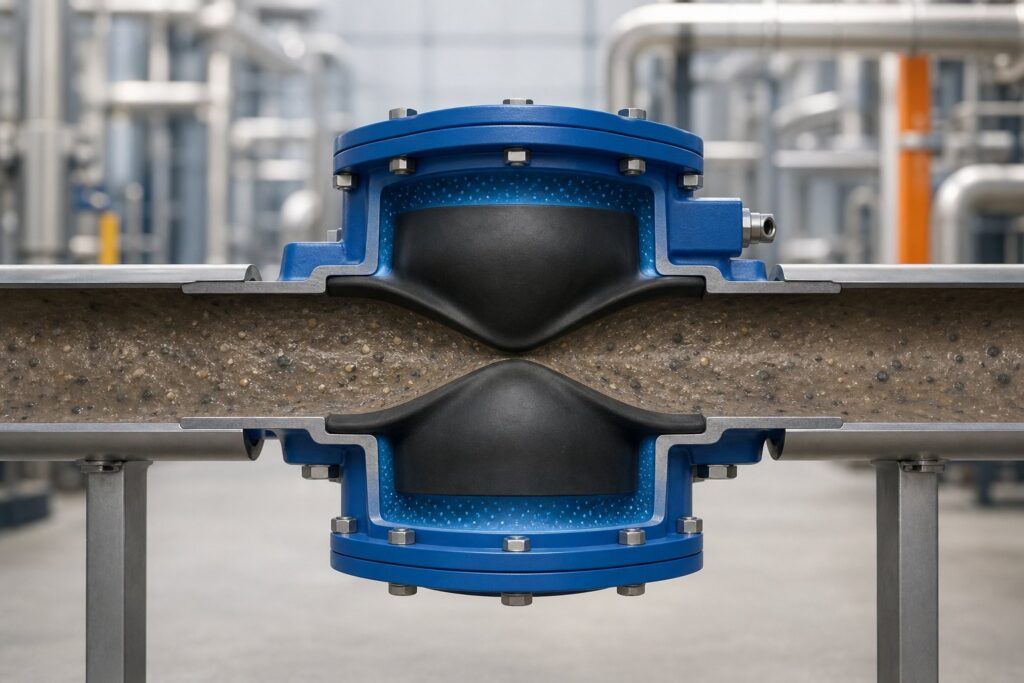
Slurries, powders, granules and other solids-bearing media can be difficult to isolate reliably. Particles may collect around a conventional seat, abrasive material can accelerate wear, and a restricted flow path may encourage build-up. A pneumatic pinch valve approaches the problem differently: the process passes through a flexible sleeve, and pressure applied around that sleeve closes the flow path.
This guide explains why that simple operating principle can be useful, what information a supplier needs to select the correct valve, and which limitations must be checked before specifying one.
How does a pneumatic pinch valve work?
Inside the valve housing is a flexible elastomer sleeve. In the open position, the sleeve returns to its normal shape and provides a direct passage for the process medium. To close the valve, compressed air or another approved control medium is introduced into the space between the housing and the outside of the sleeve. The pressure acts around the sleeve, squeezing it towards the centre until the flow path is shut.
The valve reopens when the control pressure is released. The elasticity of the sleeve helps it recover its open shape; depending on the installation, process pressure may assist.
At a glance:
- The process medium remains inside the elastomer sleeve.
- There is no disc, gate or ball positioned in the open flow path.
- The sleeve is both the closing element and the main wetted component.
- Sleeve material must be selected for the medium, temperature and duty.
Why pinch valves suit solids-bearing and abrasive media
A clear flow path when open
A correctly selected pinch valve provides a nominal-bore passage through the sleeve when open. That makes it useful where powders, granules, fibres or suspended solids could collect around internal valve components. The exact bore and connection arrangement still need to be confirmed from the model datasheet.
Closure around suspended particles
The flexible sleeve closes towards its centre line rather than forcing a rigid component onto a conventional seat. PREMAFLEX manufacturer information states that its sleeves can close even when the medium contains solid material. The particle size, shape, concentration and closing frequency should nevertheless be discussed during selection because they affect wear and service life.
Process isolation from the housing
During normal operation, the product is contained by the sleeve rather than contacting the valve housing and pneumatic control space. This can simplify material selection for some duties, but it does not remove the need to assess the housing, connections, coatings and surrounding environment.
Replaceable wear component
The sleeve is deliberately treated as a service item. Its life depends on the medium, pressure, temperature, cycling rate, control-pressure setting and installation. Planning inspection and keeping the correct replacement sleeve available can be more useful than relying on a generic service-life estimate.
Typical pinch-valve applications
Pinch valves are considered across a broad range of process duties, including:
- pneumatic conveying of powders and granules;
- wastewater, sludge and environmental technology;
- mineral, cement and construction-material handling;
- chemical and plastics processing;
- pulp, paper and fibrous media;
- food or pharmaceutical processes where the exact materials and approvals are confirmed.
These examples are starting points, not blanket suitability claims. Every application needs a model-specific check against the process conditions and any required hygiene, material or regulatory documentation.
What information is needed to specify a pinch valve?
A useful enquiry should describe the process, not just the pipe size. Send the following information where available:
- Medium: liquid, slurry, powder, granules or mixed phase, including chemical composition.
- Solids: particle size, shape, concentration and whether the material is abrasive, sticky or fibrous.
- Nominal bore and connection: pipe size, flange standard or threaded connection.
- Pressure: normal and maximum process pressure, plus any vacuum condition.
- Temperature: normal operating temperature and credible extremes.
- Control supply: available compressed-air pressure and quality.
- Operating duty: isolation, regulation or dosing, with expected cycle frequency.
- Failure position: what the process must do if control pressure is lost.
- Environment: indoor, outdoor, washdown, corrosive atmosphere, underwater or other unusual installation.
- Approvals: any food-contact, hygiene, material-traceability or industry-specific requirements.
Many pneumatic PREMAFLEX installations use control pressure above the process pressure, but the required differential varies by series and duty. It must be taken from the selected model’s current technical data rather than treated as a universal setting.
Sleeve and housing selection
Elastomer compatibility is central to pinch-valve selection. Natural rubber, EPDM, NBR, neoprene, silicone and other sleeve routes may be available across a manufacturer’s range, but their chemical resistance, temperature limits and approval status differ. The best choice cannot be made from the medium name alone; concentration, temperature and cleaning regime can change the answer.
Metal housings are commonly considered for robust general-industrial service, while engineered plastic housings can provide a route for selected chemically demanding or space-constrained applications. Connection type, pressure class and external environment remain part of the decision.
Important limitations to confirm
A pinch valve should not be treated as universally suitable simply because it can pass solids. Confirm the following before ordering:
- whether the selected model is suitable for gas-tight isolation;
- the allowable process, control and test pressures;
- vacuum capability and installation orientation;
- the required response if control pressure fails;
- temperature limits for both sleeve and housing;
- coating or construction requirements for outdoor, underwater or corrosive environments;
- inspection intervals and the correct replacement-sleeve specification.
Standard pneumatic arrangements often open when control pressure is lost. Alternative safety arrangements may be available, but the required failure position must be stated at the start of the selection process.
PREMAFLEX pinch-valve support in Great Britain
Valves4You Ltd supplies Prema-Service PREMAFLEX pinch valves, replacement sleeves, spare parts and application support for Great Britain. Available routes include metal and engineered-plastic constructions, with sleeve and control options selected around the process duty.
For manufacturer background, see the Prema-Service website.
Need help selecting a pinch valve? Send the medium, particle details, size, pressure, temperature, connection, available control pressure, cycle rate and required failure position. Valves4You Ltd can then confirm the appropriate route and any additional information needed.
Not sure which valve suits the duty? Start the Difficult-Media Duty Check.