
Blog
Replacing an Obsolete Valve: Build an Equivalence Matrix
22 October 2026
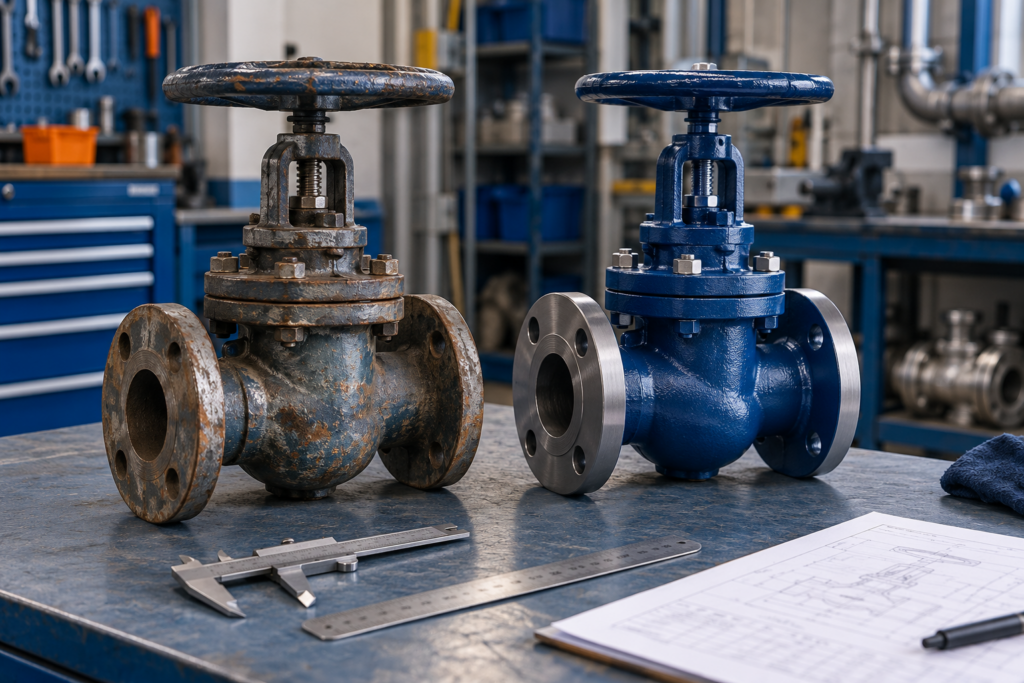
An obsolete valve cannot be replaced defensibly from nominal size, a photograph or an old model number alone. The replacement has to perform the required duty, fit the pipework and available space, integrate with the operating method, and arrive with evidence for every critical requirement.
This guide turns the search into a controlled equivalence matrix. It helps maintenance buyers and plant engineers separate confirmed matches from accepted deviations and unresolved questions before a purchase order is raised.
Quick answer
Treat “equivalent” as a documented comparison, not a product label. Record the required function and duty, pressure-temperature and wetted-material limits, mechanical interfaces, and actuation or control requirements. Mark each line as match, deviation or unknown. Resolve every safety-critical unknown and obtain current product evidence before installation. A drop-in dimensional fit does not by itself establish functional suitability.
Why an old part number is not enough
An old catalogue code may identify a family without preserving the exact trim, seat, pressure class, end connection, face-to-face series, actuator or accessories originally supplied. Plant modifications and service changes can also make the historical selection a poor baseline.
The live Valves4You specification checklist explains the general duty information needed for a quotation. An obsolete-valve replacement needs one further control: a line-by-line comparison between the installed requirement and the proposed replacement.
For pressure systems, HSE guidance asks users to know the operating conditions and safe operating limits, provide suitable equipment and ensure repairs or modifications are carried out properly. The responsible person must decide which legal, examination and change-control duties apply to the actual system.
Step 1: freeze the existing-valve baseline
Start with the best available evidence, but label its quality. Useful inputs include the nameplate and model code, purchase records, manufacturer datasheets, drawings, maintenance history, safe photographs and direct measurements. Do not assume that paint colour, handwheel size or a similar-looking body proves the internal construction.
Then separate three different things:
- Required duty: what the valve must do now, including credible extremes.
- Installed interface: what the replacement must connect to or fit around.
- Historical description: what the old records say was supplied.
If those sources disagree, record the conflict as an unknown. Do not silently choose the most convenient value.
Step 2: compare four evidence groups
| Evidence group | Existing requirement | Proposed replacement | Decision |
|---|---|---|---|
| Duty and function | Isolation, regulation, diversion or non-return; medium; solids; cycle pattern; flow direction; shut-off requirement | Manufacturer-supported function and service envelope for the offered configuration | Match, deviation or unknown |
| Pressure, temperature and materials | Normal and design values; differential pressure; vacuum or surge; all wetted materials and seals | Current pressure-temperature rating and exact body, trim, seat, seal or lining construction | Match, deviation or unknown |
| Mechanical interface | DN/NPS; flange, thread or weld standard; pressure class; face-to-face; bore; orientation; support; clearance | Dimensioned drawing, connection standard and installation requirements | Match, deviation or unknown |
| Operation, control and evidence | Manual or actuated operation; torque/thrust basis; power supply; fail position; signal; feedback; environment; tests and certificates | Complete valve-actuator-accessory package and the exact documentation offered | Match, deviation or unknown |
Duty and function
Confirm whether the valve isolates, modulates, diverts or prevents reverse flow. Record the medium, concentration, solids, cleaning fluids, operating frequency and required shut-off. A valve that fits the pipe may still be unsuitable for the required function or operating pattern.
Pressure, temperature and wetted construction
Compare normal operation and credible extremes with the current manufacturer’s pressure-temperature envelope. Include maximum differential pressure across the closed valve, vacuum, surge and test conditions where relevant. Compare every wetted component, not only the body material.
Mechanical interface
Record the connection standard, pressure class, sealing face, bore, face-to-face dimension, bolt clearance, pipe alignment, orientation, support and removal space. ISO 5752 defines basic face-to-face and centre-to-face dimension series for several metal valve types, but the applicable series still has to be identified for the specific installation and proposed model.
A dimensioned drawing is stronger evidence than a nominal size. If pipework modification, spacers, reducers or a new support arrangement are proposed, list them as deviations rather than calling the valve a drop-in replacement.
Operation, actuation and controls
For a manual valve, check direction of operation, travel, access and required operating force. For an actuated package, compare valve torque or thrust across the duty, actuator sizing basis, mounting kit, travel, power or air supply, fail action, speed, control signal, feedback, enclosure and hazardous-area requirements.
ISO 5115 treats a part-turn actuated valve as a package of valve, actuator and, where required, mounting kit. A matching actuator attachment pattern alone does not demonstrate correct sizing or package suitability.
Step 3: control deviations and unknowns
Use only three decision labels:
- Match: current evidence shows the proposed item meets the stated requirement.
- Deviation: the proposed item differs, and the responsible technical authority must decide whether the change is acceptable.
- Unknown: the evidence is missing, ambiguous or conflicts with another source.
Do not convert an unknown into a match because a quotation is urgent. Resolve safety-critical items before purchase or installation. Commercial timing can be discussed separately from technical acceptance.
Keep the completed matrix, offered datasheet, drawing, certificates, approved deviations and final part identity together. HSE’s pressure-systems Approved Code of Practice notes the value of retaining manufacturer or supplier documents and reports relevant to repairs, operating conditions and significant modifications.
Qualified examples
Same DN and flange class, different face-to-face
The new valve may connect to the same flange drilling but require pipework movement or a spacer. Record the dimensional difference, gasket and bolting implications, support and installation plan. It is not a drop-in match until the interface is checked.
Same valve body, different seat or trim
A familiar model family may be offered with a different seat, seals or trim. Compare the exact wetted construction against the medium, concentration, cleaning regime, temperature, pressure and operating pattern. The family name alone cannot approve the substitution.
Actuator flange matches, sizing evidence does not
A replacement actuator may bolt to the valve through a compatible mounting kit, yet still have the wrong torque, travel, fail action, speed or environmental rating. Treat mounting compatibility and actuator sizing as separate matrix lines.
What to send for a defensible comparison
- Existing make, model, nameplate and purchase reference, if legible.
- Safe photographs of the full valve, connections, operator and surrounding clearance.
- Dimensioned drawing or measured face-to-face, connection, bore, stem and mounting details.
- Required function, medium, concentration, solids and cleaning conditions.
- Normal, minimum, maximum and design pressure and temperature, plus differential pressure, vacuum or surge where relevant.
- Exact material, shut-off, actuation, fail action, signal, feedback and environmental requirements.
- Required testing, certification, traceability, approvals, quantity and required date.
- Known failures, changes in service and every item still marked unknown.
Send the evidence you have and label gaps clearly. Valves4You can help compare a standard replacement, an adapted arrangement or a bespoke route without presenting an unresolved assumption as a confirmed match.
Frequently asked questions
Does the same nominal size mean the new valve will fit?
No. Check the connection standard and pressure class, face-to-face dimension, bore, sealing faces, bolt clearance, orientation, support and removal space.
Can a photograph identify an exact replacement?
A photograph can reveal useful features, but it may not confirm internal materials, pressure-temperature rating, trim, seat, torque or the applicable dimensional standard. Combine photographs with records, measurements and current manufacturer evidence.
Is a compatible ISO 5211 mounting flange enough for an actuator replacement?
No. The attachment is only one interface. Confirm torque or thrust, travel, sizing margin, duty cycle, power or air supply, fail action, controls, environment and the complete mounting kit.
What if the proposed valve needs a pipework change?
Record it as a deviation. The responsible engineer should assess the modified arrangement, installation method, support, inspection and any applicable change-control or statutory requirements.
Should an unknown old material be copied into the new specification?
No. Mark it unknown and return to the current duty, failure history and required evidence. Repeating an undocumented historical assumption does not make it reliable.
Send the existing details
Send Valves4You the existing valve details, photographs, dimensions and current duty. We will help structure the comparison and identify what must be confirmed before a replacement route can be quoted.