
Blog
NAMUR Solenoids and Switchboxes: Five Package Checks
26 October 2026
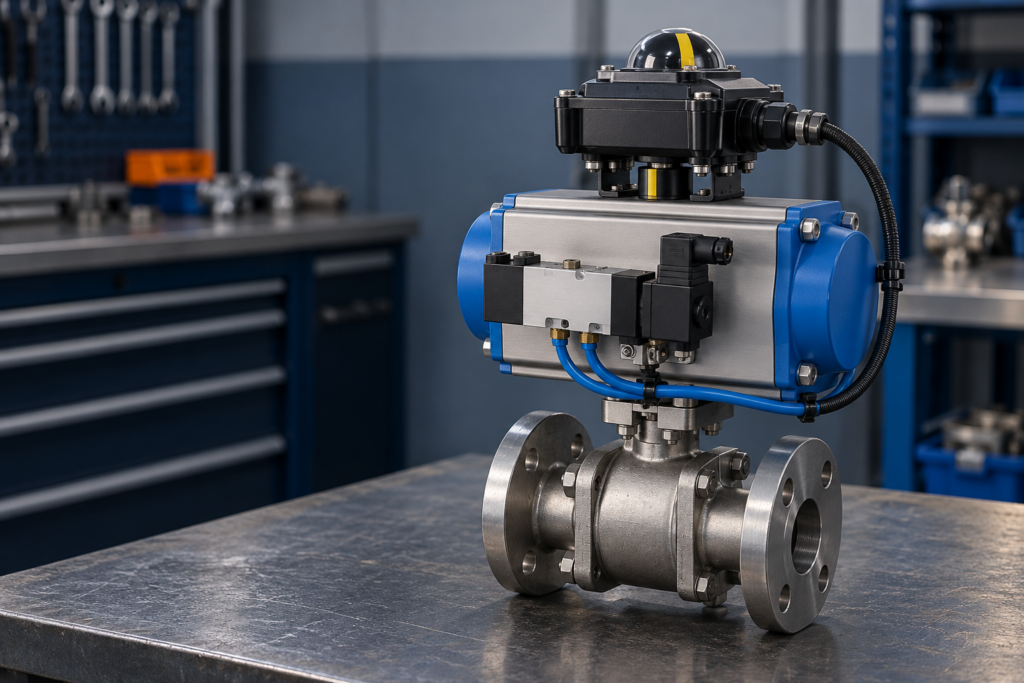
A pneumatic actuator, solenoid valve and switchbox may look like three standard accessories. In service, they form one control chain: the solenoid directs air to move the actuator, while the switchbox reports position to the control system.
The practical risk is treating one familiar word—especially “NAMUR”—as proof that the whole package is compatible. It is not. A defensible package check separates the pneumatic function, electrical supply, mechanical interfaces, environment and feedback requirements, then verifies each against the exact offered components.
Quick answer
Start with the required valve action and loss-of-supply behaviour. Then confirm five interfaces for the exact actuator, solenoid and switchbox: pneumatic function and air conditions; coil voltage, power and connection; solenoid and switchbox mounting; enclosure and hazardous-area requirements; and the feedback device, wiring and control-system input. A NAMUR mounting feature can simplify a stated interface, but it does not establish voltage, flow capacity, fail action, environmental suitability or signal compatibility.
What “NAMUR” confirms—and what it does not
Manufacturers use standardised mounting and porting arrangements to reduce bespoke tubing, brackets and couplings. Kinetrol, for example, describes a NAMUR interface that allows direct mounting and porting of solenoid valves, and a separate VDI/VDE 3845 mounting option for position-feedback units. Emerson’s ASCO Series 531 product data likewise identifies both NAMUR and threaded routes, with several pneumatic functions and electrical or environmental options.
That is useful interface evidence, not a complete package approval. The selected solenoid still has to suit the actuator type, air supply, required operating behaviour, voltage, power, connection and environment. The switchbox still needs the correct mounting, switch or sensor type, electrical rating, cable entries, enclosure and control-system compatibility.
Five interfaces to record
| Interface | Record | Evidence to request |
|---|---|---|
| 1. Pneumatic function | Double-acting or spring-return actuator; required valve action; air pressure and quality; required operating time; exhaust route | Actuator and solenoid datasheets, pneumatic schematic and manufacturer sizing or flow basis |
| 2. Electrical supply | AC or DC voltage, frequency where relevant, power, connector, duty and local manual override policy | Exact coil code, wiring data and approved connector arrangement |
| 3. Mechanical mounting | Solenoid porting/mount; switchbox pattern, bracket, shaft/coupling and travel | Dimensioned drawings and mounting-kit identity for the exact actuator size |
| 4. Environment | Indoor/outdoor, ingress, temperature, corrosion, washdown and hazardous-area classification | Enclosure data and current approvals for the complete selected options |
| 5. Feedback and control | Open/closed indication, switch or sensor type, contact/load rating, logic, terminals, cable entries and control-system input | Switchbox code, wiring diagram, set-point method and commissioning test record |
1. Match the pneumatic function to the actuator
Record whether the actuator is double acting or spring return and what the valve must do when electrical power, air supply or the control signal is lost. Those initiating events should not be collapsed into one vague “fail-safe” statement. A convertible 3/2–5/2 solenoid may support more than one arrangement, but the selected configuration, porting and exhaust route must be documented for the supplied actuator.
Also confirm available air pressure and quality, actuator volume, required travel time and any need for speed controls, quick exhaust, breather protection or a separate manual override. The solenoid’s nominal interface alone does not prove adequate flow or the intended loss-of-power action.
2. Freeze the exact electrical supply
Do not write “24 V” without identifying AC or DC. Record voltage, frequency where applicable, power or current, connector, energisation duty and the control output that will drive the coil. Check whether the selected coil and connector achieve the required enclosure or hazardous-area arrangement together.
The live Valves4You catalogue includes a NAMUR-mount solenoid family with multiple voltage and coil routes. Those options are not interchangeable evidence. The quotation and order should carry the exact coil and connector identity.
3. Confirm both mounting interfaces
Check the solenoid interface and porting against the actuator manufacturer’s drawing. Separately check the switchbox mounting pattern, bracket height, shaft or coupling, direction of travel and access for calibration. Kinetrol’s product information distinguishes direct solenoid mounting from the mounting option used for feedback units; one interface does not prove the other.
Request a dimensioned assembly drawing when components come from different ranges or when an existing package is being replaced. Include the exact bracket and coupling in the bill of materials rather than treating them as workshop details.
4. Specify the real environment
State ambient temperature, indoor or outdoor exposure, washdown, dust, corrosion, cable-entry requirements and any hazardous-area classification. A general enclosure label is not enough where the installation method, glands, plugs or connector affects the final protection. For hazardous areas, require the exact current approval and installation instructions for every relevant component; never infer approval from appearance or family name.
5. Define the feedback signal and proof test
A switchbox can provide local visual indication and remote open/closed feedback, but the internal device may be a mechanical switch, proximity sensor or another option. Confirm the contact or output type, electrical rating, logic, terminal arrangement, cable entries and compatibility with the control-system input.
Commissioning should prove the complete chain, not just individual components. Stroke the valve safely, confirm the commanded direction and required loss-of-supply behaviour, set and verify the feedback points, check the local indicator, and record the open/closed signals at the receiving system. Follow the supplied manufacturer instructions and site isolation procedures.
Qualified examples
Spring-return actuator with the wrong pneumatic configuration
A solenoid may physically fit the actuator interface yet be assembled or configured for the wrong pneumatic function. Check the schematic, actuator action, energised direction and de-energised result before calling the package complete.
Correct voltage number, wrong supply type
A 24 V AC coil and a 24 V DC coil are not the same order line. Record the supply type and exact coil code, then verify the connector and control output.
Weatherproof switchbox, incomplete cable-entry arrangement
The enclosure may carry a stated ingress rating, but the final installation also depends on suitable glands, plugs, seals and assembly. Include those items and inspect them during commissioning.
What to send for a package quotation
- Valve type, size, required travel and current actuator make/model if known.
- Double-acting or spring-return requirement and the required valve position for each loss-of-supply event.
- Air pressure, air quality, required operating time and exhaust or breather needs.
- Solenoid voltage, AC/DC, frequency where relevant, connector, power limit and control output.
- Required open/closed feedback, switch or sensor preference, contact/output rating and control-system input.
- Ambient temperature, outdoor/washdown/corrosion conditions, ingress and hazardous-area requirements.
- Mounting drawings, bracket/coupling needs, cable entries, quantity, documentation and required date.
Browse the Valves4You accessories route and actuator range, then send the complete package requirements. Valves4You can help structure the actuator, solenoid and feedback arrangement without treating one interface label as proof of complete compatibility.
Frequently asked questions
Does a NAMUR solenoid fit every pneumatic actuator?
No. Confirm the exact actuator interface, size, porting and mounting drawing, plus the required pneumatic function. Adaptors or a different mounting route may be needed.
Is a switchbox the same as a positioner?
No. A typical switchbox provides position indication and discrete feedback. A positioner regulates actuator position from a control signal. Confirm the required control function before choosing accessories.
Can one solenoid work with both double-acting and spring-return actuators?
Some named products offer configurable 3/2 and 5/2 functions, but the exact model, configuration and installation instructions must support the required arrangement.
Is an IP rating enough for a hazardous area?
No. Ingress protection and hazardous-area certification are different requirements. Specify the classified area and require current approval evidence for the exact supplied configuration.
What should be tested at commissioning?
Verify safe full travel, commanded direction, loss-of-supply behaviour, local indication, open/closed feedback at the receiving system, cable and pneumatic connections, and any required reset or proof-test record.
View accessories
Review the accessories route or send Valves4You the actuator, air, electrical, feedback and environment details for a package-specific quotation.