
Blog
EPDM, NBR, FKM or PTFE? Five Inputs Before You Shortlist a Valve Seat
19 October 2026
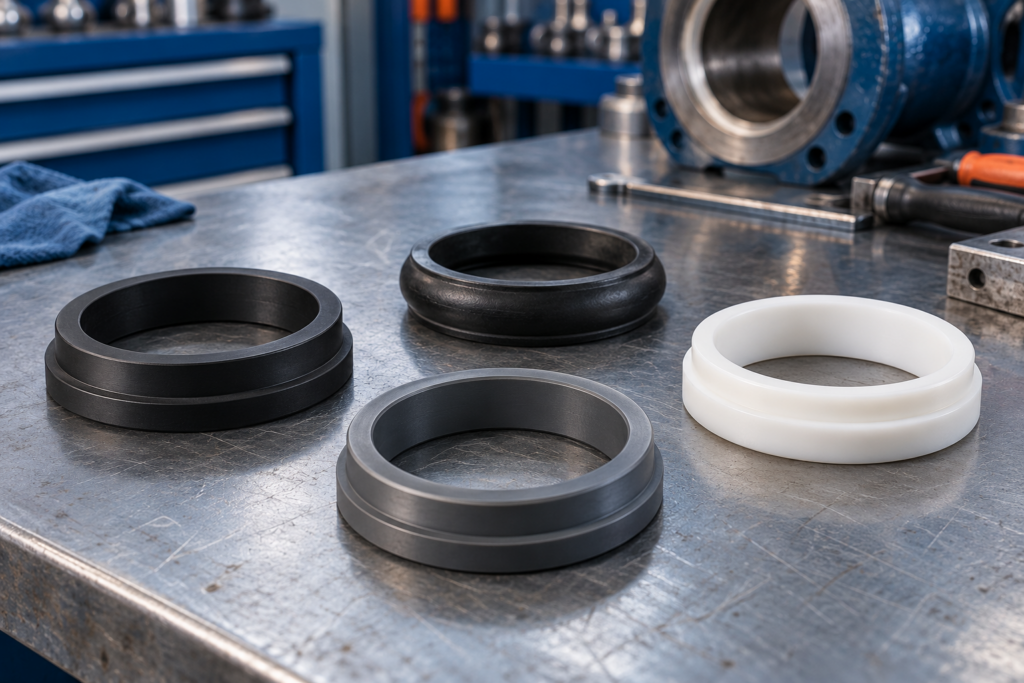
EPDM, NBR, FKM and PTFE are common names in valve catalogues, but the material family alone does not approve a seat for a duty. The medium, concentration, temperature, pressure, operating pattern and the manufacturer’s exact compound or construction all matter.
This guide shows how to build a defensible shortlist before using the Valves4You Chemical Compatibility Tool or asking a manufacturer to confirm the final valve.
Quick answer
Start with the exact medium and concentration, then define normal and credible extreme temperatures, pressure and differential pressure, operating pattern, and any approval or traceability requirement. Use compatibility charts only to screen candidates. Confirm the exact valve model, seat construction and manufacturer compound against the complete duty. Do not treat colour, a generic polymer name or one ambient compatibility rating as final selection evidence.
Why the family name is only a starting point
Parker’s O-Ring Handbook shows that seal selection depends on chemical resistance, physical properties and service conditions, and warns that useful temperature ranges can change with the medium. Trelleborg also notes that formulations within the same basic polymer family can perform differently. Those principles matter to valves because the seat must both resist the process and continue to seal in its specific geometry and operating cycle.
PTFE is a fluoropolymer rather than an elastomer. Parker describes PTFE as a sealing route when application conditions exceed the capability of elastomeric or thermoplastic materials, but a broad chemical-resistance reputation does not establish that every filled grade, seat design or supported construction suits every pressure, temperature or cycling duty.
What the four labels can tell you
| Material family | Useful first screening question | Important limitation to verify |
|---|---|---|
| EPDM | Is the duty mainly water, steam or another polar medium covered by the proposed compound? | Hydrocarbon oils and fuels can be a poor fit; confirm the exact compound, concentration and temperature. |
| NBR | Does the manufacturer support the compound for the stated oil or hydrocarbon duty? | Weathering, ozone, cleaning media and temperature limits vary; do not generalise from one NBR product. |
| FKM | Does the specific FKM grade cover the chemical mixture and temperature range? | “FKM” or “Viton” is not one universal formulation, and steam, amines or low-temperature duty may need particular review. |
| PTFE | Does the model use virgin, filled, supported or energised PTFE, and how is it retained? | Check mechanical loading, creep/cold-flow control, shut-off method and pressure-temperature limits for the exact construction. |
The table deliberately avoids universal temperature limits. A family-level range is not a substitute for the selected manufacturer’s datasheet, and a valve seat may have a different allowable envelope from an O-ring or sheet made from a related material.
Five inputs to record before you shortlist
1. Exact medium and concentration
Name every process component, including carrier fluid, additives, cleaning chemicals and credible contamination. Record concentration or composition rather than using a broad label such as “acid”, “solvent” or “oil”. If the process changes between production and cleaning, both states belong in the selection record.
2. Normal and credible extreme temperature
State normal operating temperature, start-up and shutdown conditions, cleaning temperature and credible upset or ambient extremes. Parker’s compatibility guidance makes clear that the medium can materially change a material’s useful temperature range. A generic maximum from another component is not approval for this valve.
3. Pressure, differential pressure and vacuum
Give normal and design pressure, maximum differential pressure across the closed valve, and any vacuum or rapid pressure change. These inputs affect the seat’s mechanical support, extrusion risk, sealing load and the model’s pressure-temperature envelope.
4. Operating pattern and required shut-off
Record whether the valve isolates, modulates or cycles frequently; expected cycles; dwell time; flow direction; solids or crystallisation risk; and the required leakage or shut-off class where applicable. A material that resists the fluid may still be wrong for the motion, friction, deformation or wear in a particular seat design.
5. Complete construction and evidence requirement
Identify every wetted component, not only the seat. Ask for the exact compound or grade, cure or filler where relevant, supporting geometry, disc/ball and body materials, stem seals, gaskets, lubricant, approvals, batch traceability and current manufacturer evidence. The valve is limited by the least suitable wetted or sealing component.
A practical evidence ladder
- Family screen: remove clearly unsuitable material families using a reputable guide.
- Exact-medium check: compare the precise medium and concentration, including cleaning and contamination.
- Service-envelope check: compare temperature, pressure, differential pressure, vacuum and cycling with the proposed valve model.
- Compound and construction check: confirm the manufacturer’s exact seat, backing, seals and other wetted parts.
- Approval record: retain the current datasheet, compatibility response, deviation and any required test or certificate.
The Chemical Compatibility Tool is an indicative screening aid. Its ratings are not automatically recalculated for temperature, and the page instructs users to confirm concentration, pressure, impurities, mechanical stress, exposure duration and the complete application.
Qualified examples
Water duty with an intermittent oil-cleaning step
A water-only description may initially point towards an EPDM route. If the seat is also exposed to hydrocarbon cleaning fluid, the shortlist must be checked against both process states. The answer may be a different compound or construction, but it cannot be decided from the water duty alone.
Mineral oil at ordinary temperature
NBR is commonly used for oil service, while Trelleborg warns against EPDM with mineral and vegetable oils. That is a useful screening distinction, not a final approval. The oil formulation, additives, pressure, temperature, cycling and exact valve datasheet still need review.
Aggressive chemical where PTFE appears attractive
PTFE may remain on the shortlist because of its broad chemical resistance. The next questions concern the exact PTFE grade and seat construction, the pressure-temperature envelope, support against deformation, operating torque, shut-off and all other wetted components. “PTFE seat” alone is incomplete evidence.
What to send for a defensible material check
- Exact medium names, concentrations and mixture proportions.
- Normal, minimum, maximum, cleaning and credible upset temperatures.
- Operating and design pressure, maximum differential pressure and vacuum conditions.
- Valve function, flow direction, cycle frequency, shut-off requirement and solids content.
- Size, connection, valve type and any existing model or drawing.
- All required wetted materials, prohibited materials, approvals and traceability.
- Environment, cleaning regime and expected service or inspection interval.
Use the Chemical Compatibility Tool for an initial comparison, then send Valves4You the complete duty for model-specific review.
Frequently asked questions
Can seat colour identify EPDM, NBR or FKM?
No. Colour is not reliable proof of polymer family, compound, cure, approval or traceability. Use the manufacturer’s part identity and documentation.
Is PTFE always more chemically resistant than an elastomer?
PTFE has broad chemical resistance, but the valve decision also includes the grade, fillers, support, deformation, pressure, temperature, cycling and other wetted components. Confirm the exact construction.
Can I use a compatibility chart as final approval?
No. Use it to screen options. Final selection needs the complete duty and current evidence for the proposed manufacturer, compound and valve model.
Does a higher generic temperature limit mean a better seat?
No. Temperature interacts with the medium and the seat design. The best choice is the supported construction that covers the whole duty, not the material with the highest family-level headline.
What if the medium composition is not fully known?
Mark the composition as unknown and resolve it before final selection. A supplier can state a conditional shortlist, but should not invent missing process data.
Check the complete valve duty
Send Valves4You the medium, concentration, pressure, temperature, operating pattern and evidence requirements. The family name can start the conversation; the exact compound and valve construction must finish it.